Materials, making & care
The Second Life of Coyuchi Textiles in a Quilted Jacket
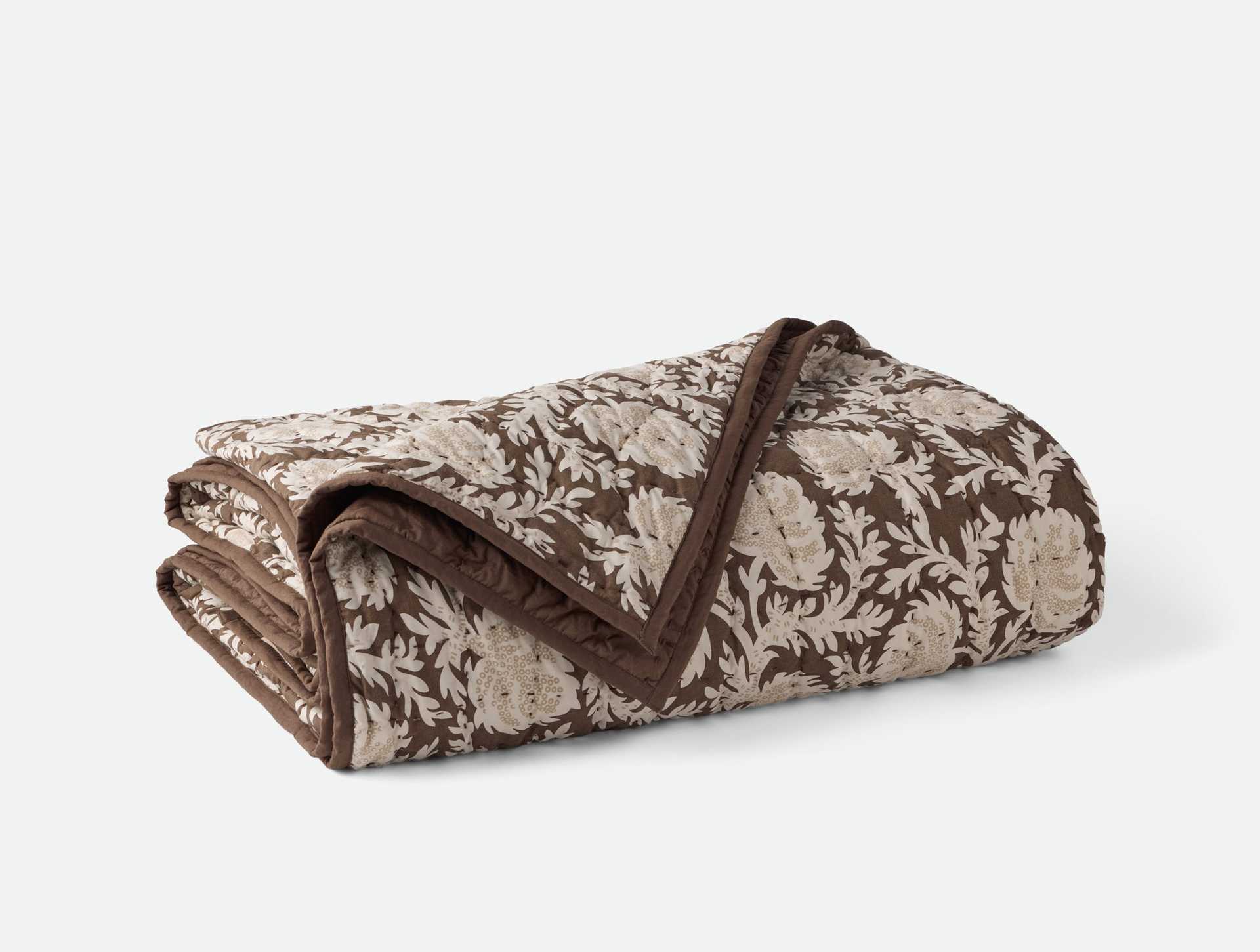
A quilt has a familiar geography: stitched lines, softened surfaces, patterns made for a bed or a quiet corner of home. In Coyuchi’s collaboration with designer Batsheva Hay, quilts, shams, and percale sheets move into a different landscape. Reworked as jackets, these reclaimed textiles carry their earlier visual character into everyday clothing.
Published November 29, 2026
When bedding becomes a garment
Textiles are often understood through their intended uses. A quilt is for warmth on a bed; a sheet is a layer against the skin; a jacket is clothing for moving through the day. Reuse unsettles those neat divisions. In this collaboration, pre-loved quilts, shams, and percale sheets become parts of a wearable object, placing the language of home textiles into a form shaped for the body.
The transformation is more than a change of category. Bedding arrives with its own history of pattern, texture, and construction. A quilt may bring visible stitching and a layered feel; a percale sheet contributes a different kind of cotton surface. Once combined in a jacket, these materials meet in a new arrangement. The garment’s character depends not on a single uniform cloth, but on how its recovered fabrics come together.
That approach gives the jacket a point of difference from clothing cut from a continuous roll of newly made fabric. According to the product information, each piece has a distinct pattern and composition. The specific arrangement of textiles can therefore vary from one jacket to another. It is a practical consequence of working with reclaimed materials, and a defining part of the garment’s appeal: the surface is particular to the individual piece.
Upcycling, in this setting, describes giving existing material a new use rather than treating it only as waste. It does not mean every reclaimed textile is interchangeable, nor does it guarantee that every part of an earlier object remains visible. The jacket is a new garment, handmade in New York, with construction and use of its own. Its connection to bedding lies in the materials from which it is made and in the distinctive fabric combinations those materials allow.
A surface with more than one story
Look closely at a garment made from repurposed textiles and the eye begins to read it in layers. There is the overall silhouette, then the relationship between its panels, colors, and patterns. Instead of a single printed design repeated across a bolt, the composition can reflect the particular combination of recovered quilts, shams, and sheets used for that jacket. The result is variation—not a flaw to be corrected, but a feature to notice.
Individuality in reclaimed clothing should be understood accurately. The available information establishes that each jacket differs in pattern and composition; it does not specify the exact history of any particular textile, how long it was used, or where it came from before it was repurposed. Those details should not be inferred from appearance alone. What can be said is simpler and more useful: the fabrics are repurposed home textiles, and their differing arrangements make each finished piece distinct.
The jacket pairs a shell made from upcycled organic cotton quilts and shams with a lining made from upcycled organic cotton percale sheets. These components give the garment a close material relationship to its former domestic context while serving different roles in the finished construction. The quilted shell is the visible outer layer; the percale lining forms the inside. The contrast is not merely a contrast of pattern, but of textile function: one material is assembled as an outer jacket surface, the other as a lining.
Such a garment asks its wearer to look at clothing as material with a past, not only as a finished object. A small shift in perspective can make construction easier to appreciate. The jacket is not a blank surface onto which a new design has been printed. It is an arrangement built from fabrics that already had color and pattern. The maker’s task is to bring those elements into a useful shape, with the final composition shaped by what the reclaimed materials offer.
Relaxed shape, considered details
The jacket has a relaxed fit, a Peter Pan collar, two side pockets, and snap-button closures at the front. These details place it within the familiar vocabulary of everyday outer layers, even as its textile composition makes it unusual. A relaxed shape can support easy layering, though the best fit depends on the wearer’s proportions and preferred way of dressing. Checking the garment’s current size information is important before making assumptions about how it will sit.
The two side pockets provide a straightforward functional detail: a place for small items or a place to rest the hands. Snap closures offer a front fastening without the appearance of a continuous button placket. The collar lends the jacket a distinct outline. Together, these elements make the reclaimed fabric part of a wearable design rather than a decorative textile study alone.
Construction details matter especially when materials have different prior forms. The product information describes the jacket as handmade and quilted, with a cotton shell and cotton lining. It does not set out a technical account of how every textile is selected, joined, reinforced, or finished. A careful description should leave those specifics open. What is clear is that the finished piece brings together reclaimed quilts, shams, and percale sheets in a jacket construction intended for everyday wear.
Because each jacket’s composition varies, close examination can be part of choosing one. A shopper can review the actual piece, where available, rather than rely solely on a general description. Look at the placement of patterns, the relationship of the shell to the lining, the finish around closures, and the arrangement of the pockets. These observations do not establish quality on their own, but they help clarify what is distinctive about the specific garment.
What reclaimed textiles can—and cannot—tell us
The idea of giving textiles a second life is compelling, but it is worth keeping the language precise. Reusing existing material can make use of resources already present in fabric, rather than beginning with an entirely new textile for every component. Yet the available product details do not quantify material savings, environmental impact, or the total amount of textile diverted from disposal. Those outcomes depend on information that has not been provided, including sourcing, manufacturing, transport, and the product’s life after purchase.
For that reason, the jacket is best understood through what is documented: its shell is made from upcycled organic cotton quilts and shams; its lining is made from upcycled organic cotton percale sheets; each piece differs in pattern and composition; and it is handmade in New York. These facts offer a meaningful account without requiring broader claims that cannot be verified from the product information.
Reclaimed fabric also brings practical questions. A buyer may want to know how much variation to expect, whether the specific garment shown is the one being purchased, and how it should be maintained. The distinct arrangement of textiles means that a general product title cannot fully describe every jacket’s appearance. If a listing provides photographs of a particular piece, those images may help communicate its composition; if not, asking for details is a sensible step.
In this way, variation shifts the usual relationship between a product description and a physical item. For a garment produced in a consistent fabric, a description may suggest a relatively uniform appearance. With reclaimed textiles, the description identifies the method and the material family, while the precise pattern arrangement belongs to each individual jacket. The distinction is useful: it sets clear expectations and makes the specificity of the garment legible.
Care for a jacket with a textile past
Care is part of the jacket’s story because use and maintenance determine how a garment remains in circulation. The supplied instructions are specific: wash cold on a gentle cycle with like colors, tumble dry on low and remove promptly, and use a warm iron if desired. Following the label or the most current official product instructions is the safest approach, particularly for a garment whose shell and lining are made from different types of cotton textile.
“With like colors” is a practical reminder to consider the garment alongside the rest of the laundry. A gentle, cold wash avoids treating it as a rugged utility item, while low tumble drying and prompt removal follow the stated care guidance. If ironing is needed, the instructions allow a warm iron. Care labels should take precedence if they differ from a general product page, and any uncertainty about a particular jacket is best resolved before washing.
Regular inspection can also help a wearer respond to ordinary signs of use. Check closures, seams, pocket openings, and areas that experience friction. This is not a special repair protocol supplied for the jacket, but a broadly useful habit for clothing. Addressing a small issue early may help prevent it from becoming more disruptive. For repairs or stains that require specialist treatment, consult a qualified clothing-care professional rather than assuming that every reclaimed textile should be handled identically.
There is a wider point here: an upcycled garment does not become durable simply because its materials have been reused. Its useful life still depends on construction, fit, frequency of wear, and care. The jacket’s stated wash instructions provide a practical starting point, while the owner’s attention over time helps determine how well it serves everyday routines.
Choosing a piece that suits your life
A distinctive jacket can invite an immediate response to its colors and pattern, but practical questions deserve equal attention. Consider when and where you expect to wear it. A relaxed quilted jacket may work as a casual layer, but the provided information does not specify insulation ratings, weather resistance, or suitability for particular temperatures. It should not be treated as technical outdoor protection without additional confirmation.
Fit is another individual matter. The relaxed silhouette may make layering part of the design, but measurements and sizing guidance are more reliable than assumptions based on a product name. Check the stated dimensions or try the garment if possible. Consider sleeve length, body length, room across the shoulders, and how the snap closures sit when fastened. These details help turn an attractive object into a comfortable one.
Then there is the question of variation. Because the pattern and composition differ from jacket to jacket, a buyer who prefers a particular arrangement should examine the exact piece whenever that information is available. Someone drawn to the idea of reclaimed textiles may welcome the unpredictability; another person may want a specific color balance. Neither response is wrong. The value lies in understanding that variation is inherent in the described design.
Finally, consider care as part of ownership rather than an afterthought. The cold gentle wash and low-heat drying instructions should fit the routines available to the wearer. A garment that requires care a person cannot reasonably provide may spend more time unworn. Good clothing choices account for the real conditions of use, from the fit of a sleeve to the likelihood that care instructions will be followed.
A different way to see ordinary materials
The Coyuchi and Batsheva Hay collaboration offers a clear example of how familiar home textiles can be reimagined as clothing. Quilts, shams, and percale sheets are not presented simply as references to domestic life; they are the documented source materials for a jacket with a relaxed fit, cotton lining, Peter Pan collar, side pockets, and snap-button front. Handmade in New York, each garment carries its own composition of reclaimed fabrics.
Its significance can be understood without turning it into a claim about every aspect of sustainable fashion. The jacket makes reuse visible through material and pattern variation. It prompts questions about where textiles go after their first intended use, how design can respond to what is already available, and how clothing can preserve traces of earlier forms. Those questions are especially useful when paired with specific information about materials and care.
In the end, the garment’s appeal is both visual and practical. The reclaimed textiles make each piece distinct; the familiar jacket details give that distinctiveness a shape suited to dressing. Care instructions help owners look after it, while accurate descriptions help them choose with realistic expectations. A second life for fabric is not an abstract promise here. It is visible in the way an old category of material becomes a new kind of everyday object—one whose pattern is particular, whose construction has a clear purpose, and whose story continues with the person who wears it.